 |
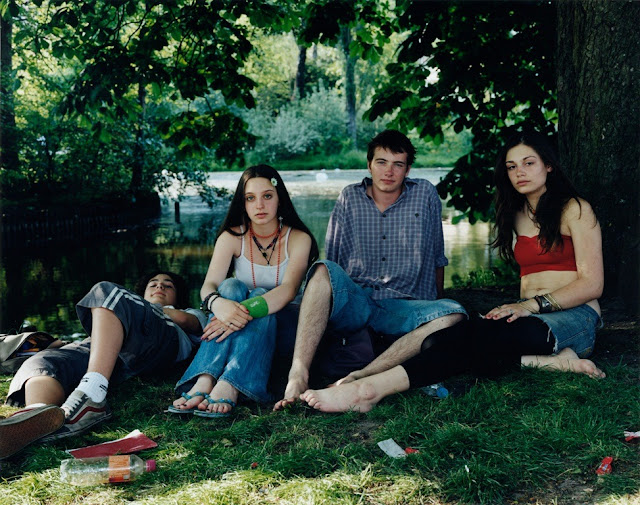
| "Vondelpark, Amsterdam the Netherlands" by Rineke Dijkstra. Chromogenic print, June 10, 2005. (via) |
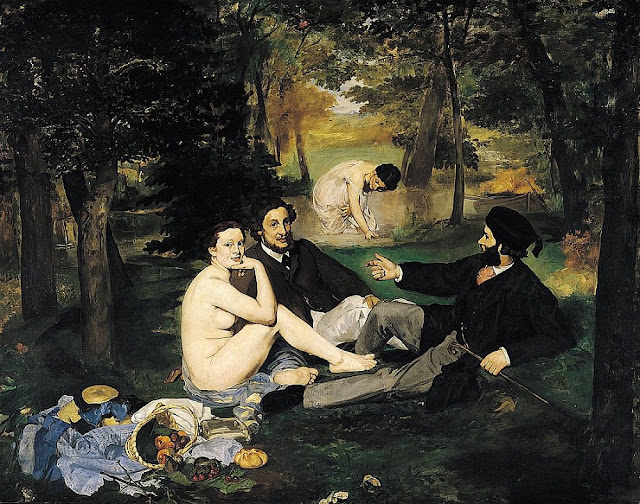 |
"Le déjeuner sur l'herbe", or, "The Luncheon on the Grass" by Edouard Manet. Oil on canvas, 1863. (via)
|
The portraiture and photography of
Rineke Dijkstra is tops. The lighting, subjects and setting of this photo are pure magic.
When I first saw this picture I was struck with its similarity to
Manet's
"Luncheon on the Grass" (in composition, not
Manet's cheeky and groundbreaking
social commentary). The clothing and open frankness of the subjects give me aches of nostalgia. I am so glad that this photo exists.
When I went scouting for more information about this picture, I found some really cool insights into
Dijkstra's lighting, method and composition from the photographer herself! The following is an excerpt from her interview with
Art Practical in which she discusses the photo below (another in her series of
Vondelpark group portraits):
 |
| "Vondelpark, Amsterdam, the Netherlands" by Rineke Dijkstra. Chromogenic print, June 19, 2005 (via) |
Interviewer: Patricia Maloney with Art Practical, March 29, 2012 (entire interview here)
PM: It’s amazing how much light becomes a character or an attribute of your characters.
RD: I’m much more precise now. In some of the beach
portraits, there’s a flash. And here, I try to keep the natural light
and just use a fill-in. So I’m pretty precise in trying to get that
[atmosphere]. You don’t really feel the flash so much here, do you?
PM: No, you don’t. In the beach portraits, the light
is so stark, almost like a barricade. In encountering the figure, you
have to also confront the light. Whereas here, it’s more …
RD: Here, it’s much more like [the subject becomes] one with the landscape.
PM: This is where painting comes to mind, especially Manet’s Le déjeuner sur l’herbe.
RD: Yes, she’s sitting the same way. It’s a total coincidence.
PM: So you didn’t construct this composition?
RD: No. And when I took this picture, I was quite
relaxed because it was the first day that I decided to take some
pictures. It was a warm day, on a Friday afternoon, and I was walking
around with my camera and an assistant. It was really crowded in the
park and these kids were just sitting there. I thought, “Let’s see if we
can do something,” and it was funny because they were not very
interested.
PM: Do you ever find it difficult to approach subjects? Do you ever get nervous about it, or are you just used to it by now?
RD: I’m used to it, and I feel that people also like it. They’re flattered. For instance, for [Vondelpark, Amsterdam, the Netherlands, June 19, 2005],
there was this family in the park: this girl and two of her sisters,
who were much younger than her, and their mother. The girl was really
surprised that I was interested in her. They thought I wanted to
photograph the baby. What I like so much is that because her dress is
red—can you imagine if this dress had been black or green?—all the
attention goes to her, and he is sort of admiring her. If it was the
opposite, if she was wearing black and he red, that would have been a
totally different picture.
PM: It’s so different from the schoolboy. Even though she’s framed by the foliage, she’s just completely open, and she owns it.
RD: Yeah, it is her picture.